Wilmette School District 39 · Parent Campaign
Real learning is unplugged
D39 should be teacher-led, not child-led.
Keep readingWhat the research shows
Higher risk of anxiety in children with 4 or more hours of daily screen time
Humanities & Social Sciences Communications (Nature), 2026
Higher risk of depression in those same children
Humanities & Social Sciences Communications (Nature), 2026
Higher odds of nearsightedness for every extra hour of daily screen time
JAMA Network Open, 2025
Measurable gain in reading, math, or science from heavy investment in classroom computers
OECD, 2015
Who We Are
Parents who believe D39 can lead on this, and will.
We are parents, doctors, scientists, and educators across Wilmette School District 39. Many of us watched our kids come home tired and distracted, glued to a screen they had been handed at school, and we started comparing notes. Learning Unplugged grew out of those conversations.
We are asking the district to reduce screen time across the board, end 1:1 devices in the youngest grades, and put real books and hands-on learning back at the center of the school day. The research has caught up with what many of us already felt, and the time to act is now, while these children are still young.
This is not anti-technology, and it is not anti-teacher. D39 is one of the strongest districts in Illinois, full of dedicated educators. We believe that together we can give our children a screen-light, book-rich education worthy of that reputation.
What We Believe
Grounded in evidence. Driven by care.
No app or device can replace a teacher who knows your child, a book held in two hands, or a classroom full of curiosity and conversation. This is not anti-technology. It is pro-child.
Young children learn best off screens.
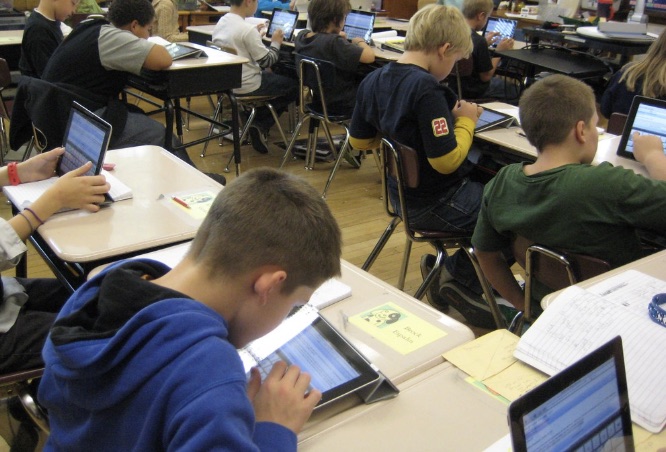
In the early grades, the deepest learning comes from real books, handwriting, hands-on materials, and a teacher's full attention. Pediatricians urge strict screen limits for young children, yet many of our students now spend hours a day on a school device.
Screens are reshaping kids' health.
Heavy screen use is tied to worse sleep, rising anxiety and depression, and measurable differences in the developing brain. The harm lands hardest on the youngest, whose minds and habits are still forming (Madigan et al., 2019; Hutton et al., 2020).
More tech has not meant more learning.
Large international studies found that schools which poured money into classroom computers saw no real gain in reading, math, or science. Too often devices distract from learning instead of deepening it (OECD, 2015; UNESCO, 2023).
Take Action
Three ways to make a difference
Sign the Petition
Add your name to our community petition calling on the D39 Board to adopt a healthier device policy. Every confirmed signature is delivered directly to district leadership.
Sign Now →Attend the Board Meeting
Show up in person. Public comment at D39 Board meetings is the most direct way for parents to be heard. We'll have a sign-in table and talking points ready.
See Events →Email Your Board Member
Use our pre-written, fully editable email templates to contact your District 39 board member directly. Personalized messages have the greatest impact.
Contact Board →The Research
The evidence is clear.
The Lancet Child & Adolescent Health (Walsh et al.) · 2018
Under two hours of daily screens linked to sharper thinking in young children
Among 4,520 U.S. children aged 8 to 11, those who kept recreational screen time under two hours a day scored higher on tests of memory, attention, and language. Screen time was the single biggest factor.
OECD · 2015
The more children use computers at school, the worse they read
Across dozens of countries, students who used computers most often at school had the worst reading results, and reading scores fell in the places that pushed the most classroom technology.
Frontiers in Psychology (Van der Weel & Van der Meer) · 2024
Handwriting, not typing, builds widespread brain connectivity
EEG recordings showed that writing by hand produces far more connected brain activity than typing, the kind of connectivity known to support memory and learning.
Educational Research Review (Delgado et al.) · 2018
Reading comprehension is stronger on paper than on screens
A meta-analysis of over 170,000 readers found that comprehension was consistently better when reading on paper than on screens, especially under time pressure.
Apps Used in D39
Know what's on your child's device.
We review the apps and platforms used across D39 schools: who owns them, what data they collect from children, and what the research says about their place in the classroom.
Meet the Founder
Rachel Ginzburg
Founder, Learning Unplugged
Rachel spent eight years at Google, working inside the industry that shapes how all of us live online. She saw firsthand how these products are built: how every notification, autoplay, and endless feed is carefully engineered to capture attention and keep us coming back.
Then she became a mom. Watching her own young children reach for a screen, she recognized the very pull she had once helped design, now aimed at the people she loves most. What is merely distracting for an adult can be overwhelming for a developing brain.
Learning Unplugged grew out of that realization. Rachel started this campaign to give D39 families what she wishes every parent had: an honest, insider's view of what screens do to children, and a practical path back to real books, real teachers, and a real childhood.
Sign the Petition
Tell the D39 Board: less screen time, more real learning.
We are asking the Wilmette District 39 Board to act on four specific steps:
- 1Cut daily screen time and end 1:1 iPads and Chromebooks in the early elementary grades, teaching core subjects on paper and face to face.
- 2Require opt-in parental consent before any 1:1 device is issued, with a real, comparable non-device option for families who decline.
- 3Publish full transparency: the list of apps and platforms in use, their vendor contracts, and the student data each one collects.
- 4Report screen-use time by grade each year so families can see the trend and hold the district accountable.
Add your name and we will deliver every confirmed signature to district leadership ahead of the next board vote.
— confirmed signatures
Share this petition